300x250 AD TOP

Search This Blog

Pages

Paling Dilihat

Powered by Blogger.

Saturday, May 19, 2012

.NET Composition

.NET 4.0 Provides an easy way for runtime or aftermarket plugins and components, its called Composition.


Before composition we had to load each assembly, check its types and create new instances, I've provided a demo in class PreCompositionInfrastructure.


Composition provides that infrastructure and more, it allows you to specify if you want only one object or multiple, you can specify imports by attribute or by method, specify exports by type or contract, lazy initialization of imports by type or contact.


You just need to add a reference to System.ComponentModel.Composition, create a catalog with directory or assembly and when one is not enough, you can aggregate catalogs.


Then you can either get specific plugins with GetExportedValue or GetExportedValues, or you can let composition do it automatically with ComposeParts, but you'll have to use property attributes to specify which properties will be populated with which plugins and if its many or just one.


On the plugin side, you need to add a reference to System.ComponentModel.Composition and specify which class is an Export of which interface/contract, of curse you have to have access to the same interface from both the imports and the exports, so I recommend using another class library for that interface(s).


And we have to have some benchmarks, but its not really an issue since most applications load plugins at startup and never touch it again and its a lot better having an easy to program infrastructure rather than a quick one if its not affecting the overall performance of the application.


For 1000 iterations:
PluginInfrastructre - 1846ms
PluginInfrastructureImports - 1951ms
(More or less the same time, deviation because of unrelated changes)
PreCompositionInfrastructure - 294ms


Tags:

Friday, April 27, 2012

Microsoft DNS Web Admin

Most if not all DNS servers have a web interface, why not Microsoft's DNS?


I decided to write one, just because I got tired from logging in to a server every time I wanted to change something, yes, I know about remote management, it wasn't an option for that particular case. time passed by and by the time I was almost done, the project was irrelevant, I did have some fun writing it though!


So here it is before you, mostly working, some parts don't, mostly tested. 


https://github.com/drorgl/MSDNSWebAdmin


If you'd like to finish it, enjoy, its on github just for that.


Project contains two interesting libraries:


Heijden.DNS - for querying everything a DNS can tell you, including a trace.


DNSManagement - C# wrapper for WMI MicrosoftDNS namespace.

Tags: , , , , ,

Tuesday, April 10, 2012

Unix to DateTime to Unix

If you need to convert from .NET DateTime to Unix datetime and back, here's how:


/// <summary>
/// Converts a unix datetime to C# DateTime
/// </summary>
/// <param name="unixTimeStamp"></param>
/// <returns></returns>
public static DateTime UnixTimeStampToDateTime(double unixTimeStamp)
{
    // Unix timestamp is seconds past epoch
    System.DateTime dtDateTime = new DateTime(1970, 1, 1, 0, 0, 0, 0, DateTimeKind.Utc);
    dtDateTime = dtDateTime.AddSeconds(unixTimeStamp).ToUniversalTime();
    return dtDateTime;
}


/// <summary>
/// Converts C# DateTime to unix datetime
/// </summary>
/// <param name="dateTime"></param>
/// <returns></returns>
public static double DateTimeToUnixTimestamp(DateTime dateTime)
{
    return (dateTime.ToUniversalTime() - new DateTime(1970, 1, 1, 0, 0, 0, 0, DateTimeKind.Utc).ToUniversalTime()).TotalSeconds;
}


From here.

Tags:

Wednesday, March 14, 2012

SQL Table Row Size

If you ever designed a table, you must have thought how much space this table will take on disk, memory, how can I estimate the amount of memory for the server etc'. well, I can't help you there, there are too many things to take into consideration to write in a short blog post.


However, I can help you with one thing, estimating the size of a row, just double it with the amount of rows you estimate will be in the table and you have a pretty close number, but you do have to know which indexes you'll have, they might even double the amount of space needed, this article will explain in detail how you can get a more accurate estimate.


Thanks to Ruchir T, who partially implemented this article, I just needed to make a few modifications and voila, you can now start estimating.


---- =============================================
---- Author: Ruchir T (http://www.west-wind.com/weblog/posts/2004/Jan/19/Sql-Server-Row-Size-Limit)
---- Create date: 01/02/2008
---- Update date: 2012-03-14 show all row info
---- Description: returns the number of bytes left to use for creating new columns
---- =============================================
CREATE FUNCTION usfTable_estimates
(    
    @tablename char(50)
)
RETURNS 
    @rettable table
    (
        TableName nvarchar(255),
       num_columns int,
       num_fixed_columns int,
       fixed_data_size int,
       num_var_columns int,
       max_var_size int,
       var_data_size int,
       null_bitmap_size int,
       row_size int,
       bytes_available int
    ) 
AS
begin 


DECLARE @num_columns int
DECLARE @result int
DECLARE @num_fixed_columns int
DECLARE @fixed_data_size int
DECLARE @var_data_size int
DECLARE @num_var_columns int
DECLARE @max_var_size int
DECLARE @null_bitmap_size int
DECLARE @row_size int

-- Find the total number of columns
select @num_columns = count(*)
from syscolumns,systypes
where syscolumns.id=object_id(@tablename)
and syscolumns.xtype=systypes.xtype


-- Find the size occupied by fixed length columns (Note: not possible to exist outside the 8060 bytes limit)
select @num_fixed_columns = count(*)
from syscolumns,systypes
where syscolumns.id=object_id(@tablename)
and syscolumns.xtype=systypes.xtype and systypes.variable=0

select @fixed_data_size = sum(syscolumns.length)
from syscolumns,systypes
where syscolumns.id=object_id(@tablename)
and syscolumns.xtype=systypes.xtype and systypes.variable=0

-- Find the size occupied by variable length columns within the 8060 page size limit

-- number of variable length columns
select @num_var_columns=count(*)
from syscolumns, systypes
where syscolumns.id=object_id(@tablename)
and syscolumns.xtype=systypes.xtype and systypes.variable=1
-- max size of all variable length columns
select @max_var_size =max(syscolumns.length)
from syscolumns,systypes
where syscolumns.id=object_id(@tablename)
and syscolumns.xtype=systypes.xtype and systypes.variable=1
-- calculate variable length storage
begin
if @num_var_columns>0
set @var_data_size=2+(@num_var_columns*2)+@max_var_size
--set @var_data_size = @num_var_columns*24
else
set @var_data_size=0
end

-- If there are fixed-length columns in the table, a portion of the row, known as the null bitmap, is reserved to manage column nullability.
select @null_bitmap_size = 2 + ((@num_columns+7)/8)

-- Calculate total rowsize
select @row_size = @fixed_data_size + @var_data_size + @null_bitmap_size + 4

-- Return the available bytes in the row available for expansion
select @result = 8060 - @row_size

--RETURN @result

insert into @rettable
select @tablename as TableName,
       @num_columns as num_columns,
       @num_fixed_columns as num_fixed_columns,
       @fixed_data_size as fixed_data_size,
       @num_var_columns as num_var_columns,
       @max_var_size as max_var_size,
       @var_data_size as var_data_size,
       @null_bitmap_size as null_bitmap_size,
       @row_size as row_size,
       @result as bytes_available
       
      return
    
end
GO
Tags: ,

Tuesday, March 6, 2012

SQL Table Space

I was doing capacity planning the other day and I needed to know which tables take how much space, how many rows they have etc'.

There's a system stored procedure for that, sp_spaceused, but it only works on the whole database or a specific table and i tried pushing its results into a table and sorting by it, but it converts the numbers to a string so the order didn't exactly worked.

so I looked in the sp's innards and wrote the following:


select stats.name,
      row_count,
       stats.reserved_page_count * 8 as reservedKB,
       stats.pages * 8 as dataKB,
       (CASE WHEN stats.used_page_count > stats.pages THEN (stats.used_page_count - stats.pages) ELSE 0 END) * 8 as index_sizeKB,
       (CASE WHEN stats.reserved_page_count > stats.used_page_count THEN (stats.reserved_page_count - stats.used_page_count) ELSE 0 END) * 8 as unusedKB
from
(
    select name, 
           
            sum(reserved_page_count) as reserved_page_count, 
            sum(used_page_count) as used_page_count, 
            sum(
                CASE
                    WHEN (index_id < 2) THEN (in_row_data_page_count + lob_used_page_count + row_overflow_used_page_count)
                    ELSE lob_used_page_count + row_overflow_used_page_count
                END
                ) as pages
                
    FROM sys.dm_db_partition_stats
    join sys.objects on sys.objects.object_id = sys.dm_db_partition_stats.object_id
        WHERE sys.objects.type = 'U'
    group by name,sys.dm_db_partition_stats.object_id
) as stats
join
(
    select name, max(row_count) as row_count
    FROM sys.dm_db_partition_stats
        join sys.objects on sys.objects.object_id = sys.dm_db_partition_stats.object_id
            WHERE sys.objects.type = 'U'
    group by name
) as rowcountstats
    on rowcountstats.name = stats.name

order by row_count desc
Tags: , , , ,

Monday, March 5, 2012

Rebuild database

While still in design and development, a database goes through many changes, tables and columns are added and removed, records are added and deleted, sometimes performance tests are performed, a data structure goes through sanity testing, indexes get fragmented, etc'.


this leaves a lot of junk in the database files, sometimes this space is reclaimed by the SQL engine and sometimes you need to ask for it specifically, that is the purpose of this stored procedure.


I've used portions of it over the years but only this time I've decided to collect all of it into a single stored procedure, the dynamic nature of the current project I'm working on makes me execute this once in a while. I thought I'd share this with you, please be aware that this should not be executed in a production environment, you must read and understand what its doing before you execute it, it might cause some serious data loss in specific cases.


To help you avoid making that mistake, I've commented all the contents of the stored procedure and put a return in the beginning of it. 


-- =============================================
-- Author:  Dror Gluska
-- Create date: 2012-03-05
-- Description: Performs cleanup/rebuild on all indexes, freeing space and accelerating queries
-- =============================================
create PROCEDURE [dbo].[usp_DBCCCleanup]
AS
BEGIN
 -- SET NOCOUNT ON added to prevent extra result sets from
 SET NOCOUNT ON;

    return;

----rebuild tables

--print 'Rebuilding tables...'

--declare @rebuildtables table(name nvarchar(255), cmd nvarchar(max));

--insert into @rebuildtables
--SELECT  o.[name],'ALTER TABLE ' + '[' + s.[name] + ']'+'.' + '[' + o.[name] + ']' + ' REBUILD ;'
--FROM sys.objects AS o WITH (NOLOCK)
--INNER JOIN sys.indexes AS i WITH (NOLOCK)
--ON o.[object_id] = i.[object_id]
--INNER JOIN sys.schemas AS s WITH (NOLOCK)
--ON o.[schema_id] = s.[schema_id]
--INNER JOIN sys.dm_db_partition_stats AS ps WITH (NOLOCK)
--ON i.[object_id] = ps.[object_id] AND ps.[index_id] = i.[index_id]
--WHERE o.[type] = 'U' ORDER BY ps.[reserved_page_count]

--declare c_rebuild cursor for select name, cmd from @rebuildtables

--open c_rebuild

--declare @tname nvarchar(255), @tcmd nvarchar(max);

--fetch next from c_rebuild into @tname, @tcmd
--while (@@fetch_status <> -1)
--begin
-- print 'Rebuilding ' + @tname
-- exec sp_executesql @tcmd
 
-- fetch next from c_rebuild into @tname, @tcmd
--end
--close c_rebuild
--deallocate c_rebuild


--print 'Done rebuilding tables'

--print 'Rebuilding indexes...'
----taken from http://technet.microsoft.com/en-us/library/bb838727(v=office.12).aspx

--DECLARE @objectid int;
--DECLARE @indexid int;
--DECLARE @partitioncount bigint;
--DECLARE @schemaname nvarchar(130);
--DECLARE @objectname nvarchar(130);
--DECLARE @indexname nvarchar(130);
--DECLARE @partitionnum bigint;
--DECLARE @partitions bigint;
--DECLARE @frag float;
--DECLARE @command nvarchar(4000);
--DECLARE @dbid smallint;

---- Conditionally select tables and indexes from the sys.dm_db_index_physical_stats function
---- and convert object and index IDs to names.

--SET @dbid = DB_ID();

--SELECT
--    [object_id] AS objectid,
--    index_id AS indexid,
--    partition_number AS partitionnum,
--    avg_fragmentation_in_percent AS frag, page_count
--INTO #work_to_do
--FROM sys.dm_db_index_physical_stats (@dbid, NULL, NULL , NULL, N'LIMITED')
--WHERE
----avg_fragmentation_in_percent > 10.0  -- Allow limited fragmentation
----AND
--index_id > 0 -- Ignore heaps
----AND page_count > 25; -- Ignore small tables
---- Declare the cursor for the list of partitions to be processed.
--DECLARE partitions CURSOR FOR SELECT objectid,indexid, partitionnum,frag FROM #work_to_do;
---- Open the cursor.
--OPEN partitions;
---- Loop through the partitions.
--WHILE (1=1)
--BEGIN
--FETCH NEXT
--FROM partitions
--INTO @objectid, @indexid, @partitionnum, @frag;
--IF @@FETCH_STATUS < 0 BREAK;
--SELECT @objectname = QUOTENAME(o.name), @schemaname = QUOTENAME(s.name)
--FROM sys.objects AS o
--JOIN sys.schemas as s ON s.schema_id = o.schema_id
--WHERE o.object_id = @objectid;
--SELECT @indexname = QUOTENAME(name)
--FROM sys.indexes
--WHERE object_id = @objectid AND index_id = @indexid;
--SELECT @partitioncount = count (*)
--FROM sys.partitions
--WHERE object_id = @objectid AND index_id = @indexid;
---- 30 is an arbitrary decision point at which to switch between reorganizing and rebuilding.
--IF @frag < 30.0
--SET @command = N'ALTER INDEX ' + @indexname + N' ON ' + @schemaname + N'.' + @objectname + N' REORGANIZE';
--IF @frag >= 30.0
--SET @command = N'ALTER INDEX ' + @indexname + N' ON ' + @schemaname + N'.' + @objectname + N' REBUILD';
--IF @partitioncount > 1
--SET @command = @command + N' PARTITION=' + CAST(@partitionnum AS nvarchar(10));
--print 'Rebuilding/Reogranizing index ' + @indexname
--EXEC (@command);
--PRINT N'Executed: ' + @command;
--END
---- Close and deallocate the cursor.
--CLOSE partitions;
--DEALLOCATE partitions;
---- Drop the temporary table.
--DROP TABLE #work_to_do;
--print 'Updating usage'
--DBCC UPDATEUSAGE (0)
--print 'Shrinking database'
--declare @shcmd nvarchar(255) = 'DBCC SHRINKDATABASE (' + DB_NAME() + ',10)'
--exec (@shcmd)
 
END


Tags:

Saturday, December 10, 2011

Book Review: Scalability Rules: 50 Principles for Scaling Web Sites

If this article hurts anyone's copyright, let me know and I'll remove it.

Scalability Rules: 50 Principles for Scaling Web Sites - on Amazon


This book was a nice read, I didn't get overexcited about it.


The book is talking about what can and can't, what should and shouldn't be done to make your application and services easier to scale, I'm including a little summary so you can judge for yourself if you want to read it.


The following is my understanding and summary of the rules and do not completely correspond with the author's, I've omitted a few rules which looked redundant to me.


Rule 1 - Write simple programs, complicated programs are hard to maintain and hard to add scaling logic to.
Rule 2 - Design the program to scale up front, its cheaper than trying to scale a finished product.
Rule 4 - Balance CDNs and DNS lookups.
Rule 5 - Reduce objects, on HTML pages, CSS files, JS files, on page creation, in code etc', remember if an object is being created it also needs to be disposed of.
Rule 6 - Use a single hardware provider, less chance of collision between protocol implementations and standards. 
Rule 7 - Horizontally scale, for example, if you're using SOA, create some services and balance the load.
Rule 8 - Split the load of the program to different components.
Rule 11 - Use small abandundly available components rather than big specialized systems, e.g. horizontally scale.
Rule 12 - Design your data to be split across data centers.
Rule 13 - Design your application to utilize what clouds have to offer.
Rule 14 - Use RDBMS where best, NOSQL where best and file-systems where best, don't force one of them to be the other.
Rule 15 - Use firewalls on every important component you're using.
Rule 16 - Use log files, monitor them, analyze them.
Rule 17 - Don't check and read what your program just did, for example, read a file you just wrote or read a transaction you just committed.
Rule 18 - Avoid using redirects, its slowing the user's experience.
Rule 19 - Avoid state constaints.
Rule 21 - Implement expires headers, otherwise caching is limited.
Rule 22,23,24,25,26 - Cache ajax requests, pages, application object, db executions, service calls, use external cache storages like memcache.
Rule 27 - learn from everything, customers, etc'
Rule 28 - Don't rely on QA, the software engineers should do most of the testing, integrate tests into the program.
Rule 29 - Design to rollback your changes, not designing for it could be a disaster.
Rule 30 - Discuss failures, no need to blame, just learn from them.
Rule 31 - Check database relationships and constraints for load, cost, normalization, etc'.
Rule 32 - Use the right database locks where they are needed. page, row, table, schema, etc'.
Rule 33 - Do not use multiphase/two-phase commits.
Rule 34 - Avoid database cursors.
Rule 35 - Do not use select *, get only the data you need.
Rule 36 - Segregate program and data so if one part of the application goes down it doesn't take the whole system with it.
Rule 37 - Single points of failure (SPOFs) will fail, eliminate or plan for it.
Rule 38 - Avoid putting systems/components in series, slows things down and has the potantial of being a domino effect of failure.
Rule 39 - Add the ability to turn on and off features in your application without recompiling the program, if one coponent acts up, you can turn it off without affecting other components until its fixed.
Rule 40 - make everything as stateless as possible.
Rule 41 - Use cookies for state instead of server state.
Rule 42 - Use distributed cache for state, its easier to scale than application state.
Rule 43 - Use async calls instead of sync calls which freeze the program until something else is finished.
Rule 44,45 - Use message buses that can scale and only where the cost to perform the action is higher than the cost to process it via message bus.
Rule 46 - Avoid using 3rd party to scale your application, it might introduce more problems than it will solve.
Rule 48 - Don't use business intelligence in your transactions.
Rule 49 - design your application for monitoring, add logs, performance counters, etc'.
Rule 50 - don't blame anyone, to the user you're the one to blame, for example, if your hardware vendor is giving you a hard time solve it or replace them.


Tags:

Thursday, November 3, 2011

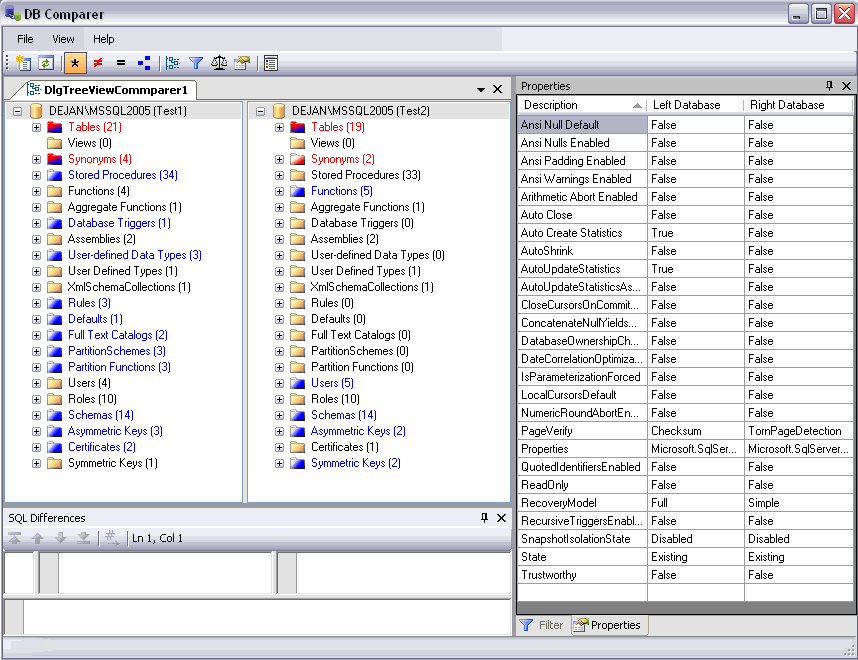
Comparing database schemas

WARNING: DBComparer comes with babylon toolbar and can't be removed by conventional ways. 

I've considered removing that post because of that but decided on adding a warning instead, to remove the babylon forced installation you'll have to get into firefox, ie and chrome, delete the new search engine and remove the default pages, in firefox you can do about:config, type babylon in the search box and delete all values.

---> Original post below.


So, you've been working on optimizing a database, stored procedures, indexes, views, you changed some of those, deleted a few and created new ones. You wrote on the side everything you did in the development database but somehow when you try to stage everything, you're not getting the desired performance or getting some exceptions about schema not being consistent. 

Now what?

Back in the days there was a project on sourceforge that made comparing database schemas a breeze, it was called dabcos. then came SQL 2008 and it stopped working, something about a version not being right. so I wrote a small override. then a new job came and I've lost the override and... no, I didn't have the time to look into it again.

So I've looked for a different option and that option is called DBComparer.


DBComparer


Tags:

Thursday, July 7, 2011

jQuery general ajax error

Over the years I've collected many code snippets to make programming easier, here's a small one that handles general ajax errors and shows them in a window, you'll need to design your own CSS for this to show properly.


//Attach global juery ajaxerror
$(window).ready(function ()
{
    $(document).ajaxError(function (e, jqxhr, settings, exception)
    {
        showError("Ajax Error - " + exception.toString(), jqxhr.responseText);
    });
});
 
//Hides the error window
function hideError()
{
    $('#mask').hide();
    $('#errorWindow').hide();
}
 
//Shows the error window.
function showError(strTitle, strMessage)
{
    //avoid showing an empty ajax message
    if ((strTitle == "Ajax Error - ") && (strMessage == ""))
    {
        return;
    }
 

    var mask = $('#mask');
 
    if (mask.length == 0) {
        mask = $('<div id="mask" class="windowMask"></div>');
        $("body").prepend(mask);
    }
 
    //Get the screen height and width
    var maskHeight = $(document).height();
    var maskWidth = $(window).width();
 
    //Set height and width to mask to fill up the whole screen
    mask.css({ 'width': maskWidth, 'height': maskHeight });
 
    //transition effect  
    mask.fadeIn(1000);
    mask.fadeTo("slow", 0.8);
 
    //Get the window height and width
    var winH = $(window).height();
    var winW = $(window).width();
 
    var errorWindow = $('#errorWindow');
    if (errorWindow.length == 0) {
        errorWindow = $('<div id="errorWindow" class="windowError"></div>');
        $("body").prepend(errorWindow);
    }
 

    errorWindow.html('<div class="windowHeader">' + strTitle + '</div><div class="windowClose" onclick="hideError();">Close</div>' + '<div class="windowContent">' + strMessage + '</div>');
 
    //Set the popup window to center
    $(errorWindow).css('top', winH / 2 - $(errorWindow).height() / 2);
    $(errorWindow).css('left', winW / 2 - $(errorWindow).width() / 2);
 
    //transition effect
    $(errorWindow).fadeIn(2000);
}
 
 
Tags: , , ,

Monday, July 4, 2011

Timesheet

One of the drawbacks of having flexible work hours is when forgetting to punch in when you enter the office. later during the week when you try to remember when did you arrive could be hard and I prefer to offload it from myself.

I don't know about you, but usually the first thing I do when I enter the office and go to my seat and unlock the computer and the last thing is locking the computer.

My solution? write an application that logs these events.

So, what can we learn from that application?

SessionSwitch event which passes SessionSwitchReason that can tell you what happened, if the station was locked, unlocked, remote desktop connected, disconnected which was enough for me, I wanted the application to log whenever I lock the station since I don't usually shutdown the computer at the end of the day and i wanted it to log whenever I connect remotely in the morning so if I work from home that day, I can get that logged too.

We can get the currently logged in username with WindowsIdentity.GetCurrent()

Invoking methods asynchronously with MethodInvoker

Accelerating LINQ to objects queries with PLINQ's AsParallel

Interlocked.CompareExchange as a simple way of checking if a method is already executing.

Final thoughts - 

I wrote the initial application a long time ago, but I've recently overhauled the the whole application so it will be more presentable, there are still some logical problems, such as the daily calculations and weekly calculations sometimes show incorrect data and there are some extreme situations when something is not logged consistently it will show wrong numbers, but this is good enough for me and not worth spending more time, I'm mostly using the logging function, the calculations are just for getting a rough number.

This is a toy for myself, I just thought to share it, if you need any kind of reliability or tracking, this toy is not for you.


timesheet


Tags: